Unified Namespace

One data layer for your entire production. Real-time, historical, and use case ready.
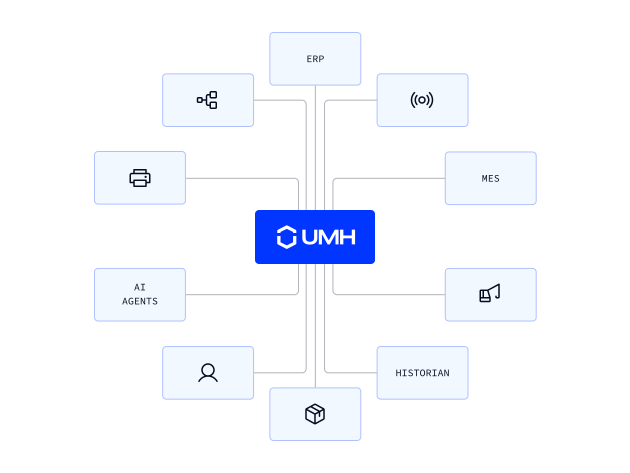

Connect your data sources once. Use them everywhere. UMH builds the Unified Namespace for your factory and extends it beyond real-time: data contracts, historian access, and transaction support make it ready for ERP, analytics, and AI. Not just a broker. A complete data layer.
See how it fits your setup
Explore the platform
Data contracts enforce quality and guarantee transactions
Runs in your infrastructure, no cloud dependency
Connect once, reuse across all systems
Zero data loss with store-and-forward
Historian built in, not just real-time
100% open source (Apache 2.0)

Trusted by global enterprises

The Challenge

Every use case is built as a point-to-point integration. It doesn't have to be.

Every new use case means a new integration
OEE, energy monitoring, predictive maintenance, AI. Each one needs its own data pipeline, its own connections, its own format. Point-to-point, every time. And use cases that could share data and context don't, because nothing connects them.
Current systems can't handle the load and can't adapt
Your MES and historian weren't built for the volume modern use cases demand, and they're too rigid to change when requirements do. Adding a new source means a change request, a consultant, and weeks of waiting.
Use cases need more than data. They need context and structure.
Dashboards, automation, and AI don't work on raw machine signals. They need to know what a value means, what's normal, which machine produced it. That's what a Unified Namespace provides: one place to store, govern, and serve contextualized production data.
"We produce almost 20 million fasteners per day. That generates enormous amounts of data. Machine data, energy data, production orders. But it was all in separate systems. We had the data. We just couldn't use it."
Head of Processes, Digitalisation and Applications
Read the full story >
Our solution

Connect. Model. Integrate. Build. One namespace, unlimited use cases.

UMH builds your Unified Namespace, not just as a real-time event bus, but as a complete data layer. Templatize connections across assets. Model everything along ISA-95. Enforce quality with data contracts. Real-time and historical data from one namespace, ready for any use case.
Connect a machine, model it along ISA-95, and turn it into a template. The next machine of the same type takes minutes, not days. Data standards, naming conventions, and ISA-95 structures are built into the template, so every new connection follows the same model from the start. The Management Console makes this accessible to OT engineers without writing code. Scale across assets and sites without re-engineering.
Connect once, templatize, reuse everywhere
Machine signals, errors, processes, and transactions become structured production data before they reach any application. Your engineers define what a value means, what's normal, how it relates to the process. Data contracts enforce that structure. Every system that reads from the UNS gets clean, governed data. No application needs direct access to your machines. You protect your vulnerable production assets while making data freely and easily available.
Model and contextualize at the source
Your ERP, MES, SCADA, and databases each connect to the UNS once. Data flows up, orders and commands flow back. Adding a new system doesn't mean building new integrations to every existing system. It means one connection to the namespace. Store-and-forward ensures data arrives even when connections drop. No gaps, no manual reconciliation.
Integrate any system
A Unified Namespace is normally just an integration layer. UMH extends it with historical data capabilities, making it the full backbone for all your use cases. Energy monitoring, OEE, predictive maintenance, AI, each one builds on the same real-time and historical data. Train models, analyze trends, trace root causes. Your team spends time on the use case, not on getting data ready.
Build use cases, not infrastructure

<5 days
From idea to live use case
18 min
New machine connected with templates
190%
Faster rollout to additional plants

From data standards to production use cases in four steps

Step
Define your data standards

Start with ISA-95 as your foundation. Lean into existing standards like OPC UA Companion Specifications or your own naming conventions. Define how data should be structured, named, and governed across your organization. This becomes the blueprint for everything that follows.

step
TEXT
Define your data standards
Who:
Jeremy (CTO)
Format:
Video call with screen sharing

The format:

  • 30 minutes to code.
  • 15 minutes to discuss what you'd change to make it production-ready.

The format:

  • 30 minutes to code.
  • 15 minutes to discuss what you'd change to make it production-ready.

The format:

  • 30 minutes to code.
  • 15 minutes to discuss what you'd change to make it production-ready.

The format:

  • 30 minutes to code.
  • 15 minutes to discuss what you'd change to make it production-ready.
Step
Map your machine and system landscape

Inventory what you have: which machines produce which data, which protocols they use, what's already available, and what needs to come from other systems. Plan how to deploy. This is where integration architecture happens, through the Unified Namespace instead of classical point-to-point.

step
TEXT
Map your machine and system landscape
Who:
Jeremy (CTO)
Format:
Video call with screen sharing

The format:

  • 30 minutes to code.
  • 15 minutes to discuss what you'd change to make it production-ready.

The format:

  • 30 minutes to code.
  • 15 minutes to discuss what you'd change to make it production-ready.

The format:

  • 30 minutes to code.
  • 15 minutes to discuss what you'd change to make it production-ready.

The format:

  • 30 minutes to code.
  • 15 minutes to discuss what you'd change to make it production-ready.
Step
Connect your data sources, faster than point-to-point

Pre-built templates for OPC UA, S7, Modbus, MQTT, and more. Your ERP, MES, and databases each connect once to the namespace. Because everything runs through the Unified Namespace, adding a new source is one connection, not a web of integrations. Store-and-forward keeps data flowing even when connections drop.

step
TEXT
Connect your data sources, faster than point-to-point
Who:
Jeremy (CTO)
Format:
Video call with screen sharing

The format:

  • 30 minutes to code.
  • 15 minutes to discuss what you'd change to make it production-ready.

The format:

  • 30 minutes to code.
  • 15 minutes to discuss what you'd change to make it production-ready.

The format:

  • 30 minutes to code.
  • 15 minutes to discuss what you'd change to make it production-ready.

The format:

  • 30 minutes to code.
  • 15 minutes to discuss what you'd change to make it production-ready.
Step
Build your use cases on the unified data foundation

The data is already there, structured, governed, and historical. Energy monitoring, OEE, shift reports, AI. Go live in days, not months. Every new use case builds on what's already connected.

step
TEXT
Build your use cases on the unified data foundation
Who:
Jeremy (CTO)
Format:
Video call with screen sharing

The format:

  • 30 minutes to code.
  • 15 minutes to discuss what you'd change to make it production-ready.

The format:

  • 30 minutes to code.
  • 15 minutes to discuss what you'd change to make it production-ready.

The format:

  • 30 minutes to code.
  • 15 minutes to discuss what you'd change to make it production-ready.

The format:

  • 30 minutes to code.
  • 15 minutes to discuss what you'd change to make it production-ready.

Frequently asked questions.

What is a Unified Namespace?

A single source of truth for all production data in your organization. Every machine, system, and application publishes to and reads from one namespace. It replaces point-to-point integrations with one connection per system.

How is UMH different from an MQTT broker like HiveMQ or EMQX?

A broker is one component. UMH is the complete platform: connectivity, data modeling, data contracts, Management Console, historian, and store-and-forward. You don't need to assemble five tools around a broker.

Does UMH replace our MES or ERP?

No. Your MES and ERP connect to the UNS as data sources and consumers. UMH sits below them as the data layer.

How does pricing work?

Per-site licensing, not per-connector or per-data-point. Typical investment is $25-50K per year per site. No surprise overages as you connect more machines.

How long does deployment take?

First machine connection takes about 90 seconds through the management console. A production pilot with multiple machine types typically runs 4-6 weeks.

START WITH UMH

Build your Unified Namespace. Start with the first use case.

Talk to our experts about your data architecture. Or explore the platform yourself, fully open source.
Talk to our team
Explore the platform